


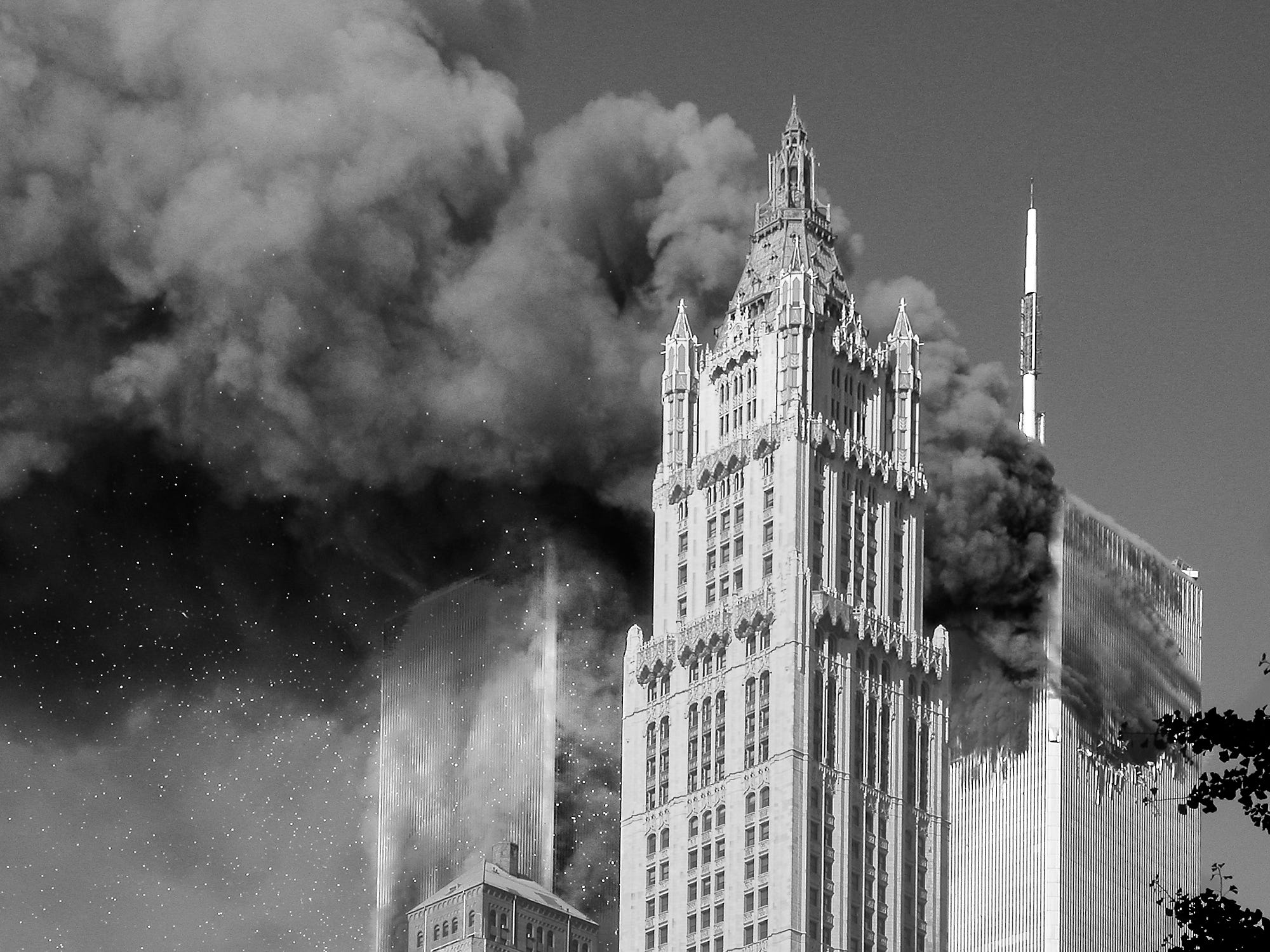
The Beatles’ monumental song “A Day in the Life” ends with an entire orchestra methodically and demonically rising in a massive accelerating crescendo until reaching an impossible apex, and then a huge crashing catastrophic boom which decays glacially to oblivion. Possibly the single most freighted musical note of the twentieth century, and in my own life inextricably linked to the infinitessimal moment that the second plane slammed into its destined tower, with the accompanying explosion that encompassed every possible audible frequency and probably all the inaudible ones too.
I’ve written about this many times over the past quarter century. The achingly beautiful day, the explosion directly above me as the plane came from the other side of the building, the large object—an engine?—whizzing overhead and landing somewhere behind me.
The massive blast of heat—I’ve only heard one other person recount this, on a television show. Why? Did I imagine it? Was it not a massive blast? Not that hot? The atom I refer to as Me splitting at that instant into the version that said “you’re about to burst into flames, you’re finished” and the other version, the perpetual observer, the anthropologist, who sat on my shoulder and whispered “this is fascinating—remember this, every last picosecond”.
The anthropologist prevailed, and for twenty-five years I’ve been remembering. Every last picosecond.
Over three thousand people died that day, most of them within a hour of my taking the photograph above, most of them in or close to those buildings. They got up, got out of bed, dragged a comb across their head… And then they perished. There is nothing that can be said that hasn’t already been said, nothing that can encapsulate or convey or assuage the complete and utter tragedy of their loss, and the shattering of the lives of all who loved them.
Twenty-five years is a blink, yet it’s a long time when measured against our mortal span. Almost half of the world’s current population wasn’t yet born in 2001. To them—to those of them who even know what happened that day—I suppose it’s equivalent to how I think of historical events that happened between 1937 and 1962, the twenty-five years preceding my own birth. The Hindenburg disaster. Pearl Harbor. Hiroshima. The Cuban Missile Crisis. All ancient history. And yet 9/11 feels so recent, so present and so raw—when I allow it to intrude, that is. We become adept at walling things off.
I’m tempted to talk about what we learned, about where we are as a nation, as a species even but, given our recent history, to do so would be to somehow desecrate a moment of profound personal reflection for each and every one of us.
May we never forget.
A brilliant synopsis, a powerful memory, and that photo! We all remember where we were that day but you were THERE! The only thing I could add to this or any memorial is a lament that we lost a “teachable moment.” Certainly not 9/11 itself, nor the chaotic days afterward. But in the past 25 years, how often have you ever heard anyone talk about the motive for 9/11? US foreign policy in Palestine, our troops in Saudi Arabia, etc. Only madmen fly planes into buildings but only fools settle for calling them “mad” and refuse to consider any possible provocation for such an outrage. We still haven’t “processed” 9/11 in that way and it seems unlikely that we ever will.
So vivid. As clear as the day it happened.