

Adieu, Balzac...

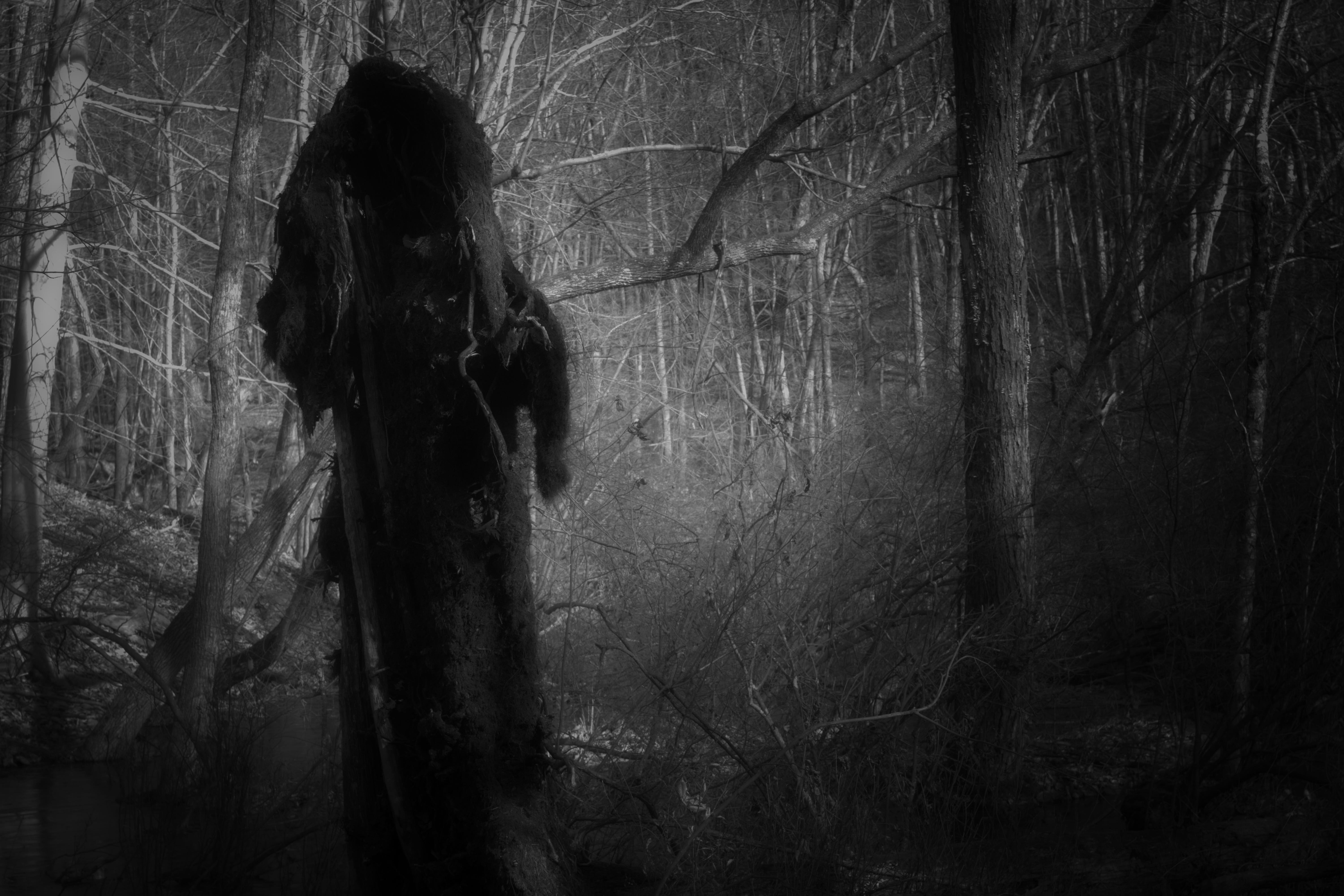
I know my neck of the woods incredibly well, having trodden its paths, both major and minor (and even non-existent), for more than two decades. That's enough time to develop an intimacy with a place, even a rambling old forest. Actually, it's not an old forest at all. Until they were restored in the 1920s, these woods were farmland for a few hundred years, and before that the Lenape (the indigenous people of these parts) herded deer up into an enclosure for sustenance (theirs, not the deer’s) during the winter months. This deer pound gave the park its name, the Ward Pound Ridge Reservation (“Ward” was tacked onto the name to honor a local politician) So the woods that I walk in are mainly secondary growth, certainly not pristine virgin forest, despite some very old stands.
The natural cycles of attrition have taken their toll. I used to think that downed trees were the symptom of something unhealthy or wrong, but really that’s just part of the cycle of death and rebirth, that the processes of decay and rot are the progenitors of new growth that sustains myriad other species.
All that said: it's accelerated. Rapidly. The natural cycles are suddenly anything but natural; the health of the forest is contingent on a sustainable rate of decay, but the sheer volume of carnage now far exceeds the capacity of natural cycles to maintain anything resembling an equilibrium. The woods of twenty years ago, with their smattering of downed trees, bear little resemblance to the woods I walk in now, which in places look like they’ve been visited by a cataclysm. The wreckage is everywhere, vast tracts of forest laid waste by huge rainstorms (that loosen the soil) followed by ruthless winds (that bring enormous trees crashing to earth.) And other unnatural forces, like the emerald ash borer, imported from Asia, have wreaked their own species of havoc on the woods throughout the Eastern United States, leaving wide skirts of bark, stripped off by woodpeckers, around each victim. Five years ago these skirts were ubiquitous; now the ash trees are all pretty much gone (I wrote about our own doomed ash tree here.)
Even as I write this, a great rain has just ended, and the sky has turned a dark, sickly brown. The big winds are coming again tonight, bringing, no doubt, a new wave of destruction. There’s a looming wooded hillside in the Res about two hundred yards from the house. When the winds descend they howl through the trees on the hill’s flanks with an unearthly banshee wail that’s both thrilling and terrifying.
So why Balzac? I suppose I should have started with him. Balzac, in this telling, isn't the French writer, but rather the magnificent root structure of a large tree that was felled by the wind sometime in the past decade. Awkwardly upended, the roots rise about twenty feet, perpendicular to their natural orientation. I first became aware of him (yes, definitely a him, not a her) peering over a rise adjacent to one of my regular paths through the Res. The resemblance to Rodin’s sculpture of Honoré Balzac, which I’d photographed in Paris a few years earlier, was striking:


My father died in 2018, a few months before I first saw Balzac, who became a source of solace and strange comfort during the year I was saying kaddish for my dad (which I wrote about in an article for Tablet magazine). Over the past six years I’ve visited and photographed him numerous times, in the teeth of winter as well as in the weightless wonder of a northern spring, marveling at his gravitas and also at his ability to endure. I mean, that’s just dirt caught in decaying roots, right?
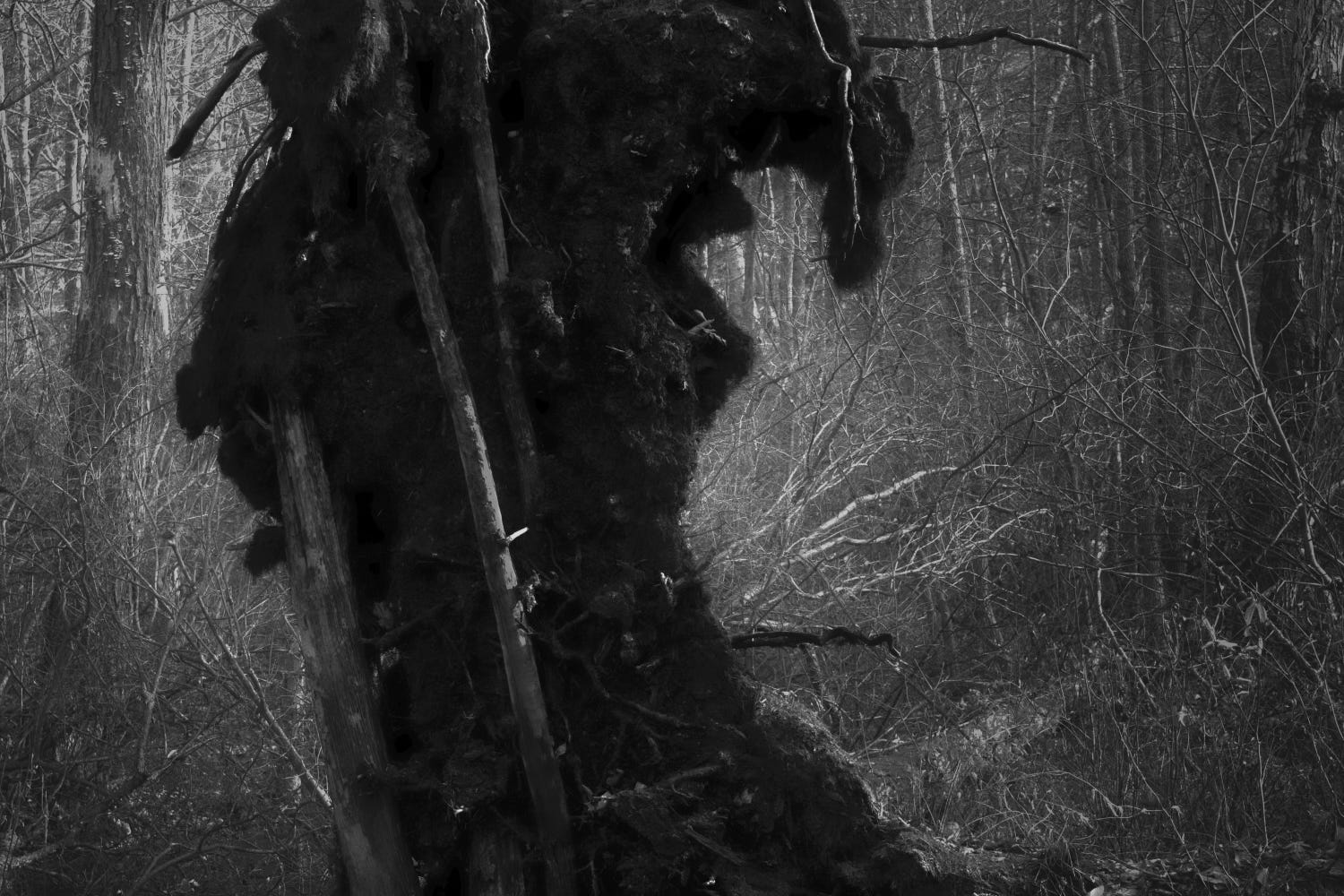
Yesterday was a disconcertingly warm day, at least for late February. Usually the ground is frozen solid this time of year, under a thick blanket of snow. Not these days—and yesterday was almost balmy, not quite tee-shirt balmy, but not that far off. Another rainstorm threatened. It was grey and the sky was maraudering (my word, not a typo). The ruin and despair of all the trees downed this winter and in the past few years, the accelerated destruction, was more evident than ever. I thought to seek Balzac’s enduring counsel, but as I did, it occurred to me that our time together was probably drawing to an end. A premonition, perhaps—and, as it turns out, one that came a little too late. I rounded the curve to take my private, familiar walk the last few dozen yards to his lair, next to a little pond, and this was the sight that greeted me:
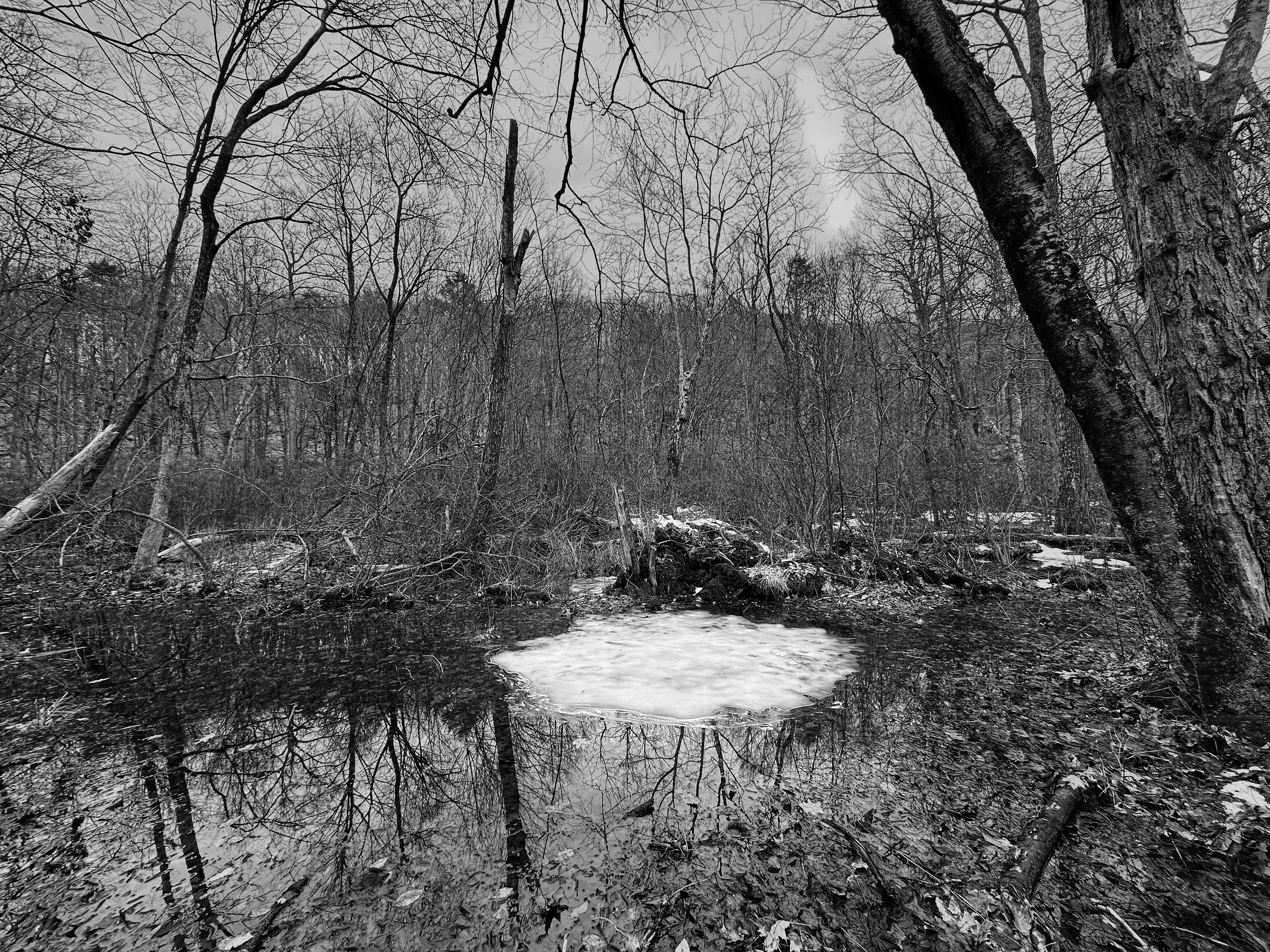
Balzac! My brother! Balm to my troubled soul! My beautiful stoic friend! There is so little left of you, you who once loomed so mighty!
I walked up to the big rock nearby, the one that looks over the hills of the lower Hudson Valley towards the river and beyond. And one more time, I said kaddish.
You always paint such a moving picture of life both in words and pixels. I remember finding a group of trees after a few close people to me had passed away. One branch arched over the wooded path like a long cradling arm and I called the whole lot of them my “Band of Brothers.” (I know. There’s a book). Brought me such comfort. Hard to see any tree go down. But you’ve immortalized your Balzac.
JM - this is so beautiful. I would encourage you to find a home for it which is even broader than Substack.